Business Capabilities: A Practical Approach to Smarter Decision-Making
Let’s talk about Capabilities – a term that might sound abstract, but is actually quite straightforward. Simply put, capabilities describe what a business does.
Every business has them. It’s how you achieve your goals. But while most organisations are comfortable mapping out their processes, fewer take the time to analyse their capabilities. That’s a missed opportunity.
In Business Architecture, capabilities can be grouped into tiers or broken down into layers – but let’s not get too technical. What’s more important for most organisations is this: documenting and analysing your capabilities can help you make better business decisions and prioritise investment.
So, what’s the point of documenting capabilities?
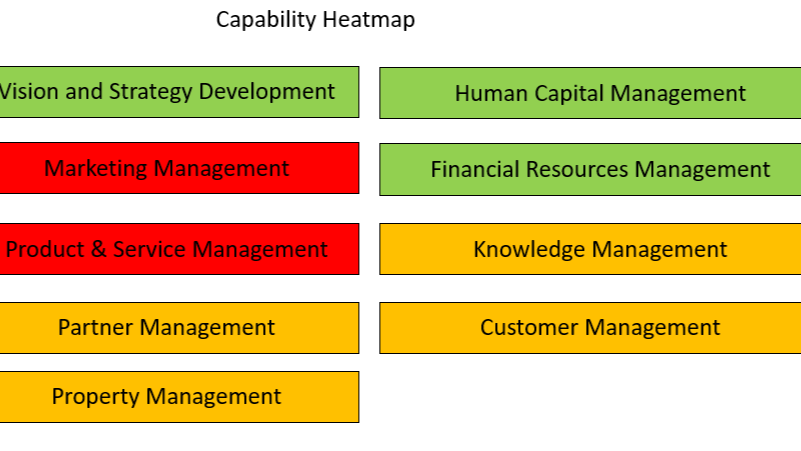
Once you map out what your business does – its core capabilities – you can go a step further by assessing their maturity. This is where heatmapping comes in.
Using a simple scoring system, you can rate each capability:
- Red: Needs immediate attention
- Amber: Adequate but could improve
- Green: Performing well
This gives you a clear visual of where to focus limited resources. You might choose to start with the Red-rated areas that have the biggest impact on your goals.
Here are a few real-life examples where I’ve used capability modelling to drive results:
🔄 Business Model Change
In a recent project with a charity (referenced here), they needed to evolve their business model. Understanding their current capabilities – and the new ones needed – was crucial in making the transition work.
🚀 New Product Launch
Ever had a clever sales pitch go a bit too far? One client promised a 3-month free trial, but the billing system was set up to bill annually and right away. In another case, a sales team sold volume-based discounts on a product, but the billing system only billed a flat rate per transaction. Work arounds in both cases involved our good old friend – excel spreadsheets Capability analysis highlighted these as the some of the most pressing issues causing huge manual workloads, so initiatives were created which helped align sales with operational reality.
💰 Finance Transformation
In a finance overhaul project, we documented all finance capabilities and heat mapped them. We then created initiatives to improve the capabilities and a 5-year benefits realisation plan. Post-implementation, we revisited the capability model, updated it with the improvements made (reds became green or at least an amber at yr1), and we adjusted our benefits forecast based on the continuous improvement roadmap. This became a recurring, annual review cycle for the client.
🤝 Capability Optimisation after Acquisitions
After a series of acquisitions, one organisation ended up with several teams scattered around different countries doing similar work in different ways across different locations. Capability modelling helped reveal areas of overlaps and gaps. We eventually designed an optimised model, combining internal teams, shared services, and outsourced capabilities.
When I first started my foray in Business Architecture few years ago, it all seemed so theoretical and abstract. But if you can take little parts of these ideas out of the abstract, they become incredibly useful. Capability modelling isn’t just a theoretical exercise – it’s a way to bring structure and clarity to real business problems.
So next time you’re facing a change, challenge, or investment decision, ask yourself: Do I really understand what my business is capable of doing today – and what it needs to be capable of tomorrow?